


If you have an old amalgam filling that needs to be removed, you may be wondering if there is a way to minimise your exposure to mercury during the process. Unlike a conventional filling replacement, SMART amalgam removal involves a specific series of protective measures that are designed to reduce exposure to mercury particles during the procedure.
In this guide, we walk you through the complete SMART amalgam removal journey, from your initial consultation to the removal process, replacement restoration and aftercare, so that you know exactly what to expect every step of the way.
Before Your Appointment
Preparing for your SMART amalgam removal consultation is an important step in ensuring that your appointment runs smoothly and that you make the most of your time with the dentist. While no extensive preparation is required, bringing the key information helps your dentist better understand your health and provide more personalised recommendations.
Before your appointment, we suggest the following:
- Bring along any previous dental records or X-rays that you might have. This allows your dentist to review your oral health history and avoid unnecessary repeat investigations.
- Prepare a list of current medications and/or supplements you are taking.
- Think about your symptoms and concerns, including pain, temperature sensitivity, cracks or changes around the filling.
- Inform your dentist if the tooth has been previously filled, fractured or treated with other dental procedures.
- Consider your long-term oral health goals. Being clear on this helps your dentist to recommend treatments that align with your needs and preferences.
- Write down any questions you might have so that you can direct them to your dentist during the consultation.
- Arrive a few minutes early. This allows you to settle in before your appointment and fill in the necessary registration forms without rushing.
Consultation
Once you are comfortably settled, your consultation begins with a conversation, not a clinical examination. Your dentist takes the time to get to know you, understand your symptoms and concerns and learn more about your overall health. This may include questions about your symptoms, concerns and goals around a SMART amalgam removal.
Your dentist may also review your medical history, including any previous treatment of the affected tooth. If you have any questions or concerns about the treatment, this would be the best time to bring them up.
Importantly, having an amalgam filling does not automatically mean that it should be removed. As holistic dentistry takes a more conservative approach to treatment, your dentist will only recommend a removal after assessing the condition of the tooth.
Examination
Following your consultation, your dentist will conduct a comprehensive dental examination to assess the restoration and the tooth supporting it.
Clinical Examination
Your dentist will carefully assess the amalgam filling, the affected tooth and the surrounding tissues to identify signs of damage, decay or other concerns that need to be addressed before removal.
During the examination, your dentist may assess:
- The size and location of the amalgam filling
- The existing fillings for signs of wear, leakage or failure
- Cracks, fractures or weakened areas within the tooth
- The amount of healthy tooth structure remaining
- Signs of decay around the filling
- Your bite to identify signs of uneven biting forces or teeth grinding
- The health of the surrounding teeth and gums
This assessment helps your dentist to determine whether a SMART amalgam removal is appropriate or if other restorative options are more suitable.
Digital Imaging
In many cases, your dentist will carry out digital imaging to assess the structures in your mouth that cannot be seen during a visual examination. These may include:
- Dental X-rays
- Intraoral photographs
- Digital intraoral scans
These scans allow your dentist to detect hidden decay under or around an existing restoration. Not every patient requires every type of imaging, and your dentist will only recommend the investigations that are necessary for your individual circumstances.
Determining Whether a SMART Amalgam Removal is Suitable
Once your consultation and assessment are complete, your dentist will determine whether a SMART amalgam removal is necessary or appropriate for your unique needs.
Having an amalgam filling does not automatically mean that you need an amalgam removal. If the filling is still intact and functioning well, a removal might not be necessary. However, if there are signs of recurrent decay, damage or cracks, a removal could be the best course of action.
If a removal is recommended, your dentist will discuss the treatment process, potential risks and benefits, and the replacement restoration options available after removal. This allows you to carefully consider your options before making an informed decision on your treatment.
Planning Your Replacement Restoration
When embarking on your SAFE amalgam removal journey, it is important to remember that removal is only one part of the treatment. Once your old amalgam filling has been safely removed, the remaining cavity has to be restored.
Before starting your treatment, your dentist should discuss the possible replacement restoration options with you. The most appropriate restoration for you depends on the following factors:
- Size of the existing amalgam filling
- Amount of healthy tooth structure remaining
- Location of the tooth
- Amount of bite force the tooth is exposed to
- Whether cracks or decay are present
Depending on your specific needs and oral health, some possible replacement restoration options include:
- Biomimetic composite filling for small to medium-sized cavities
- Zirconia inlay or onlay for medium to large-sized cavities or teeth that require a stronger restoration
- Full dental crown if the tooth is extensively damaged
Regardless of the final restoration of choice, the goal is always to preserve as much healthy natural tooth structure as possible, where clinically appropriate.
SMART Amalgam Removal Process
The Safe Mercury Amalgam Removal Technique (SMART) was developed by the International Academy of Oral Medicine and Toxicology (IAOMT) to reduce exposure to mercury vapour and amalgam particles during the removal of amalgam fillings. SMART incorporates multiple protective measures for both the patient and the dental team throughout the procedure.
Preparing the Treatment Room and Patient
Before the treatment begins, the dental team prepares the necessary equipment and protective measures. Once the treatment room is ready, the patient will be positioned comfortably in the dental chair. Local anaesthesia is usually administered around the affected tooth to allow the patient to feel comfortable throughout the treatment.
Separating the Tooth from the Mouth
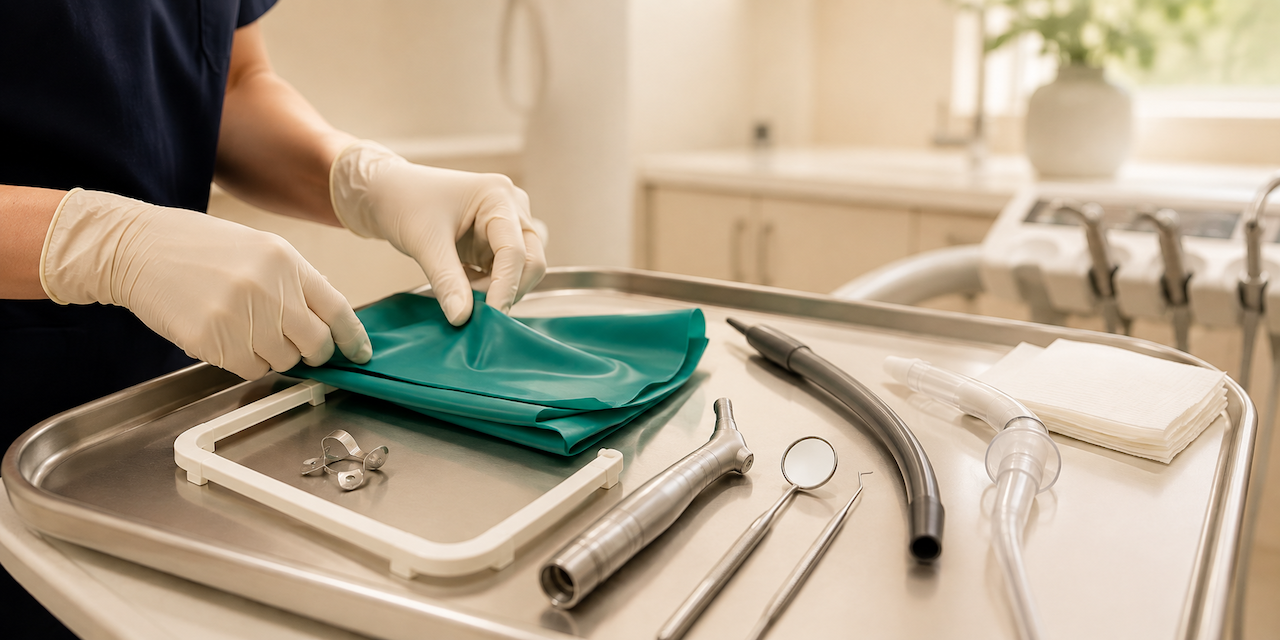
Next, a non-latex dental dam is placed around the treatment area to separate the affected tooth from the rest of the mouth. This thin protective sheet helps to prevent amalgam particles from coming into contact with the surrounding tissues or being swallowed during removal. Additional protective barriers are also placed around the face, head and neck, while a saliva ejector is positioned beneath the dental dam to provide further protection during the procedure.
Protecting the Patient
Several additional protective measures are used throughout the procedure to minimise exposure to mercury vapour and amalgam particles. You will be given an external source of air or oxygen delivered through a nasal mask, allowing you to breathe clean air away from the treatment area. A high-volume suction is also positioned close to the tooth during removal to capture the mercury vapour and amalgam particles. Together with the dental dam, these protocols provide multiple layers of protection for both the patient and the dental team present.
Removing the Amalgam
When all the safety protocols are in place, your dentist will begin to remove the amalgam filling. Instead of unnecessarily grinding the entire filling into fine particles, your dentist will remove the filling in larger pieces where possible. This helps to reduce the amount of mercury vapour and fine amalgam particles during the procedure.
A continuous stream of water is used to keep the filling cool, while high-volume suction is positioned close to the tooth to capture particles and vapour as the amalgam is removed. Throughout the removal, your dentist will take care to preserve as much healthy natural tooth structure as possible.
Cleaning and Assessing the Tooth
Once all of the amalgam has been removed, the area will be thoroughly cleaned, and your dentist can assess the tooth underneath. Removing an old filling can sometimes reveal problems that were otherwise not visible, such as hidden decay, cracks or weakened areas of the tooth.
Depending on the findings, your dentist may need to remove additional decay or address the other underlying issues before the tooth can be restored. In some cases, the originally chosen restoration may have to be adjusted to ensure that there is sufficient support and protection for the remaining tooth.
Restoring Your Tooth After Amalgam Removal
After the amalgam filling has been safely removed, the next step is to restore the area and protect the remaining tooth structure. The type of restoration recommended depends on the size of the original filling, the amount of healthy tooth structure remaining and the condition of the tooth underneath.
Smaller cavities may be suitable for a composite filling and can often be completed during the same appointment. On the other hand, larger cavities may require a zirconia inlay or onlay to provide additional strength and support. Inlays and onlays require custom laboratory fabrication, and you will have to return after one to two weeks to have the final restoration fitted and bonded.
After Your Treatment
After a SMART amalgam removal, most patients can return to their normal daily activities immediately. If local anaesthesia was used, it may take a few hours for the numbness to dissipate. During this time, patients are encouraged to avoid eating to prevent any accidental biting of the cheek, lip or tongue.
Some patients may experience mild sensitivity to hot or cold foods or drinks, or biting pressure after treatment. This is temporary and improves over time. While it may take some time to get used to your bite, if you experience significant discomfort or worsening pain, contact your dentist immediately so that the restoration can be assessed.
Looking After Your New Restoration
Proper care is required to ensure that your new restoration stands the test of time.
Some important tips include:
- Brush twice daily using a soft-bristle toothbrush and fluoride toothpaste
- Floss daily to remove plaque and food debris
- Attend regular dental check-ups
- Attend regular professional dental cleanings
- Avoid habits that place excessive stress on your teeth, like biting on ice or pens, using your teeth to open packaging or clenching or grinding
- Wear a nightguard if you grind your teeth
Your Long-Term Oral Health Journey
SMART amalgam removal is more than simply removing an old filling. A considered approach involves determining whether removal is appropriate, taking the necessary precautions during the procedure and restoring the tooth in a way that preserves as much healthy natural tooth structure as possible.
At kohe™ Dental, our holistic dentist carefully assesses each amalgam restoration and recommends a treatment approach based on your individual needs. If you have an existing amalgam filling and are concerned about its condition or would like to explore removal options, book a holistic consultation with our team today to find out whether SMART amalgam removal may be suitable for you.