


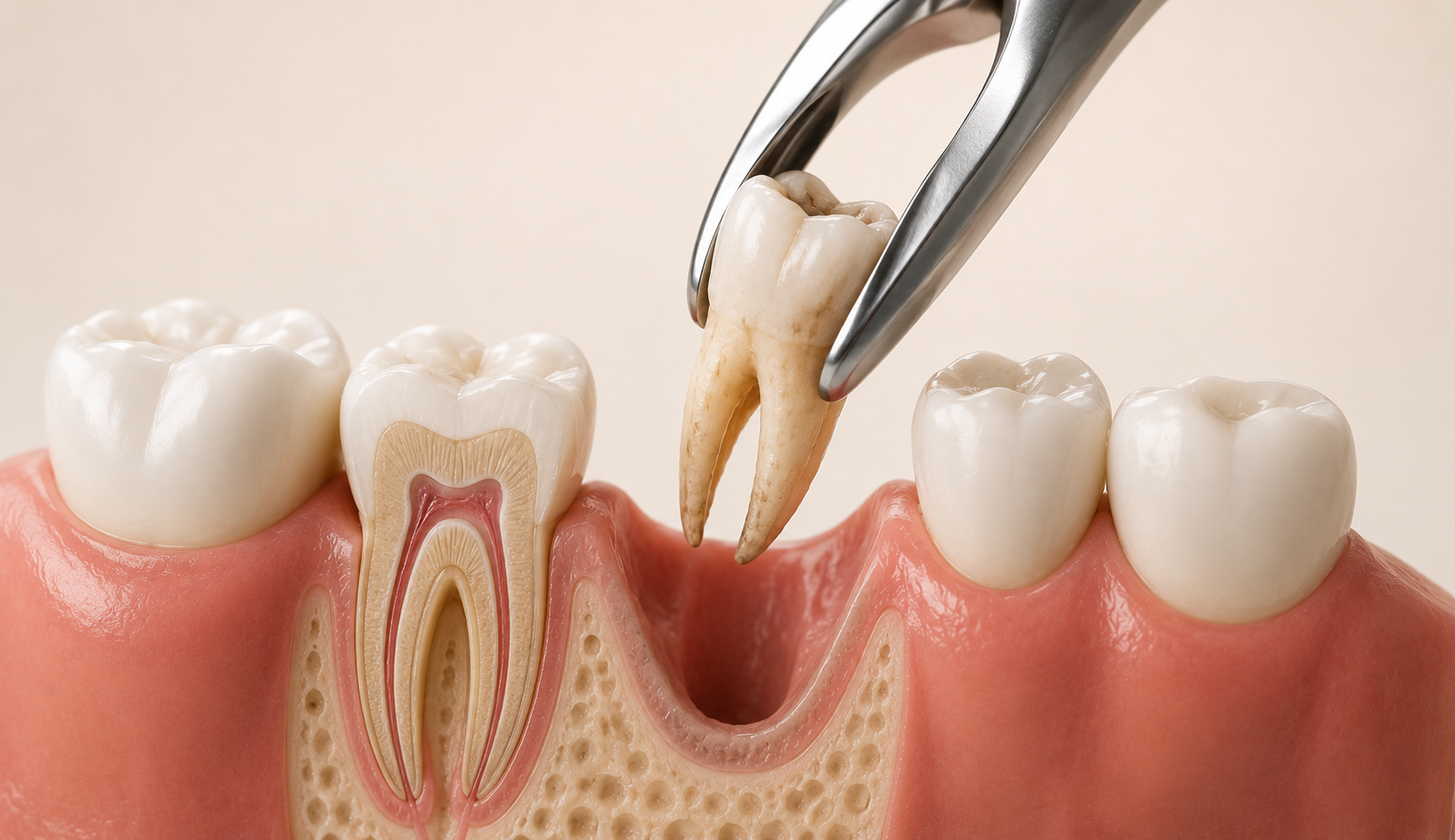
A root canal-treated tooth is not necessarily a permanent solution. Although root canal treatment is highly successful, the tooth can still become damaged, reinfected or fractured years after the procedure. If the tooth can no longer be predictably restored, removal may be the best option.
In this guide, we explain the cost of removing a root canal-treated tooth in Singapore, what is included in the treatment and the factors that affect the overall price.
What is Removal of a Root Canal-Treated Tooth?
The removal of a root canal-treated tooth is a procedure where a tooth that has previously undergone root canal treatment is extracted because it cannot be otherwise restored or maintained. While root canal treatment has an excellent long-term success rate, complications may occasionally occur over time. If these issues cannot be solved through other treatment methods, an extraction might be the best option to preserve your oral health.
A root canal-treated tooth may fail for several reasons, including:
- Persistent or recurrent infection: While a root canal treatment can remove all of the infected tissue from a tooth, bacteria may occasionally reinfect the root canal system. In such cases, an extraction might be the best option.
- Vertical root fracture: Root canal-treated teeth tend to be more fragile than healthy teeth and may develop cracks over time. A vertical root fracture allows bacteria to enter the surrounding tissues, leading to an infection. Such fractures are generally irreparable, and a tooth removal is the most predictable treatment option.
- Extensive tooth decay: Decays may still develop around a tooth after root canal treatment. If the decay is too extensive or if there is insufficient healthy tooth structure left, an extraction may be necessary.
- Severe structural damage: Although root canal treatment removes infection from inside the tooth, it does not make the tooth indestructible. If too much of the tooth has broken away or been damaged by decay, there may not be enough healthy tooth left to repair it. In these cases, extraction may be recommended.
How Much Does Removal of a Root Canal-Treated Tooth Cost in Singapore?
The cost of removing a root canal-treated tooth in Singapore varies depending on the complexity of the case and whether additional procedures are required. While some root canal-treated teeth can be removed through straightforward extraction, others may require more complicated surgical procedures. Some patients might also be recommended for a bone graft or ridge to preserve the bone and prepare the area for future tooth replacement.
Understanding the average cost of each component can help you better estimate the overall cost of your treatment.
Average Cost of Removing a Root Canal-Treated Tooth in Singapore
|
Treatment |
Estimated Cost in Singapore |
|
Simple Tooth Extraction |
$150-$350+ |
|
Surgical Tooth Extraction |
$400-$1,200+ |
|
Bone Grafting (If Required) |
$600-$2,500+ |
|
Ridge Preservation (If Required) |
$600-$2,000+ |
Removal of Root Canal-Treated Tooth Cost at kohe™ Dental
|
Treatment |
Cost at kohe™ Dental |
|
Simple Tooth Extraction |
From $200 ($218 with 9% GST) |
|
Complex Tooth Extraction |
From $720 ($784.80 with 9% GST) |
Root Canal-Treated Tooth Extraction
Removing a root canal-treated tooth costs between $150 and $1,200+ in Singapore, depending on the complexity of the extraction. While some teeth can be removed through a simple extraction, others may require surgical removal if they are severely damaged. The final treatment fee depends on the condition of the tooth, the complexity of the extraction and whether additional restorative procedures are required.
Bone Grafting
Bone grafting costs between $600 and $2,500+ in Singapore, depending on the size of the defect and the complexity of the procedure. It may be recommended after a tooth has been removed if there is significant bone loss due to infection or if you are planning to replace it in the future. Bone grafting helps preserve the shape and volume of the jawbone, promotes healing and creates a stable foundation for future tooth replacement.
Ridge Preservation
Ridge preservation costs between $600 and $2,000+ in Singapore. This procedure is performed immediately after the tooth is removed to minimise shrinkage of the surrounding bone and gum tissue during healing. However, not every patient requires this procedure. Your dentist will carefully evaluate the condition of the remaining bone structure and surrounding gum tissue before recommending the treatment.
Removal of Root Canal-Treated Tooth Cost at kohe™ Dental
The cost of metal-free ceramic dental implants at kohe™ Dental starts from $200 ($218 with 9% GST) per implant. The final treatment fee depends on the condition of the tooth, the complexity of the extraction and whether additional restorative procedures are required. During your consultation, your dentist will conduct a comprehensive assessment and recommend additional imaging, such as an X-ray or CBCT scan, if necessary. Based on these findings, you will receive a personalised treatment plan with estimated costs before you proceed with any treatment.
What Is Included in the Cost of Removing a Root Canal-Treated Tooth?
The exact treatment process for removing a root canal-treated tooth varies depending on the condition of the tooth, the reason for extraction and the health of the surrounding bone and gums. While the specific steps may differ between patients, the process generally involves a comprehensive assessment, detailed treatment planning, careful tooth removal and follow-up care to ensure that the area heals well for any future restorations.
Comprehensive Assessment
Treatment begins with a thorough assessment of your oral health to determine whether tooth removal is necessary. Your dentist reviews your medical and dental history, discusses your concerns and symptoms, and carries out a detailed examination of the tooth and surrounding gums and teeth. This allows your dentist to identify the underlying cause of your symptoms and determine the most appropriate treatment for your needs
Digital Imaging and Treatment Planning
After your dental assessment, additional diagnostic scans are usually required to assess the condition of the tooth and the surrounding structures. This typically includes dental X-rays and a cone beam computed tomography (CBCT) scan. The results of these scans help determine whether a simple or surgical extraction is required and identify whether additional procedures such as bone grafting or ridge preservation may be beneficial.
Tooth Removal
Once the treatment plan has been finalised, the tooth will be carefully removed under local anaesthesia. The exact technique depends on the condition of the tooth and the complexity of the extraction. Wherever possible, your dentist will use gentle extraction techniques to preserve as much healthy surrounding bone and gum as possible.
Bone Grafting/Ridge Preservation (If Required)
In certain cases, your dentist may recommend bone grafting or ridge preservation after the tooth is removed. This often applies to patients who have suffered infection or if a dental implant is part of future treatment plans. These procedures help minimise the shrinkage of the jawbone, support healing and preserve the natural shape of the extraction site.
Healing and Follow-Up
Once the tooth has been removed, the surrounding tissues need time to heal before any further treatment is considered. The length of the healing period depends on the complexity of the procedure and whether a bone graft or ridge preservation was performed. During this period, your dentist will arrange follow-up appointments to monitor your healing and assess the condition of the area. Once the affected area has completely healed, you may begin discussing suitable tooth replacement options.
What Factors Affect the Cost of Removing a Root Canal-Treated Tooth?
If you have compared the cost of removing a root canal-treated tooth across different dental clinics, you might have realised that the costs vary. This is because no two patients are the same. Factors such as the condition of the tooth, the complexity of the extraction and whether additional procedures are required all influence the complexity of the treatment. Understanding the factors that influence the price of treatment can help you make a more informed decision about your care.
Complexity of the Extraction
One of the biggest factors that affects the cost of the procedure is how difficult the tooth is to remove. While a simple extraction may suffice for some root canal-treated teeth, others may require more complex surgical removals. For example, if the tooth has become severely weakened, it may break during the extraction, requiring the dentist to remove it in several sections. In other cases, the tooth might have multiple roots that remain firmly attached to the surrounding bone, making it more challenging to remove. These complications require more time and expertise and thus are generally associated with higher treatment fees.
Bone Loss Around the Tooth
If a tooth has been infected for a long time, it may be suffering from bone loss, which makes the treatment more complex. After the extraction, your dentist may recommend restorative procedures such as bone grafting or ridge preservation to support the healing of the jawbone. This is particularly important if you are considering replacing the missing tooth with an implant in the future. As these procedures require extra time and materials, they increase the cost of the treatment.
Additional Procedures Required
The final cost of your extraction depends on whether any additional procedures are required as part of your treatment plan. This may include diagnostic imaging, such as X-rays or a CBCT scan, bone grafting, ridge preservation or sedation where appropriate. These treatments are usually charged separately from the extraction fee.
Can MediSave or Insurance Help Cover the Cost?
Whether you can use MediSave or claim from your dental insurance depends on the type of treatment you require and the terms of your individual policy.
Routine tooth extractions are generally not claimable under MediSave. However, if the extraction forms part of a more complex surgical procedure, such as the removal of impacted teeth or other approved surgical treatments, MediSave may be applicable. Your dentist will advise you whether your treatment qualifies.
If you have private dental or health insurance, some policies may provide partial reimbursement for tooth extractions or related procedures. As coverage varies between insurers and plans, it is advisable to check with your insurance provider before commencing treatment.
At kohe™ Dental, our team will guide you through the available payment options and advise you on any applicable Medisave claims to help you better plan for your treatment.
What Should You Consider When Choosing a Dentist?
When comparing dental clinics, it may be tempting to base your choice on the cost of the treatment. However, successful extraction also depends on the dentist’s skills and level of experience. Choosing a dentist who carefully assesses your individual needs and oral health is more important than just going for the cheapest option available.
Comprehensive Assessment and Diagnosis
Before recommending implant removal, your dentist should conduct a thorough assessment to determine the cause of the tooth's failure. This includes a review of your symptoms, a clinical examination, and diagnostic imaging such as an X-ray and CBCT scan. Identifying the underlying cause of your symptoms is important, as not every root canal complication requires removal. Following your consultation, you should have a clear understanding of your diagnosis, the available treatment options and the reasons why a particular treatment has been chosen.
Gentle Extraction Technique
The way that a tooth is removed can significantly impact the healing process and your future treatment options. An experienced dentist should take extra care to preserve as much natural surrounding bone structure and gum tissue as possible. This is especially important if you are considering filling the gap with a dental implant in the future, as it requires sufficient healthy bone structure to provide a stable base for the restoration.
Prioritises Tooth Preservation
Wherever possible, preserving your natural tooth should be the preferred treatment option. Instead of immediately recommending an extraction, your dentist should carefully assess whether the tooth can be predictably restored through other procedures such as a root canal retreatment, apicoectomy or a new restoration. If tooth removal is the only option, the reasons should be clearly explained to you.
Long-term Treatment Planning
Removing the failing tooth is only one part of the entire treatment journey. Before beginning treatment, your dentist should discuss what to expect during the healing process, whether additional procedures are necessary and the possible tooth replacement options. You should also receive a detailed breakdown of the expected costs. Understanding the treatment plan from the outset reduces the likelihood of unexpected costs down the line.
Frequently Asked Questions
How much does the removal of a root canal-treated tooth cost in Singapore?
The cost of removing a root canal-treated tooth in Singapore ranges from $150 to $1,200+. The final cost of your treatment depends on the complexity of the extraction. While some teeth can be easily removed through a simple extraction, others may require more complex surgical removal methods. Additional restorative procedures, such as bone grafting or ridge preservation, may also increase the overall cost of the treatment. A comprehensive dental assessment is required to determine the exact cost of your extraction.
Is removing a root canal-treated tooth painful?
The extraction is performed under local anaesthesia, so you should not feel any pain during the procedure. Once the anaesthesia wears off, some mild discomfort, swelling, or tenderness is expected for a few days. These symptoms can be easily managed with over-the-counter pain medication and generally subside as the area heals.
Can a failed root canal tooth be saved instead of removed?
In some cases, yes. Before recommending an extraction, your dentist will first assess whether your tooth can be predictably preserved. Depending on the underlying cause of the problem, treatment options such as root canal retreatment, apicoectomy or replacing a damaged filling or crown may be possible. However, if the damage to the tooth is too extensive, an extraction might be the best option for your long-term oral health.
Will I need a bone graft after the tooth is removed?
It depends. Whether you require a bone graft after the extraction depends on the condition of the surrounding bone and your long-term treatment goals. Bone grafting is usually recommended when there is significant bone loss or if you wish to fill the gap with a dental implant.
What are my options after removing a root canal-treated tooth?
Common options after removing a root canal-treated tooth include: dental implants, dental bridges, or removable dentures. In some cases, especially if the missing tooth is at the back of the mouth, a replacement may not be immediately required. Your dentist will share the benefits and limitations of your available options and recommend the option that best suits your oral health.
Book a Consultation
If you are experiencing persistent pain, swelling or other symptoms around a root canal-treated tooth, it may be a sign that the tooth requires further assessment. Early diagnosis can help determine whether the tooth can still be preserved or if removal is the most appropriate treatment.
At kohe™ Dental, our holistic dentist takes the time to understand your needs, thoroughly assesses your oral health and develops a personalised treatment plan that suits your unique needs.
Book a consultation with our dedicated dental team today to receive a personalised assessment and tailored recommendations to help you restore your smile.